
Items
Tag
Evolution
-
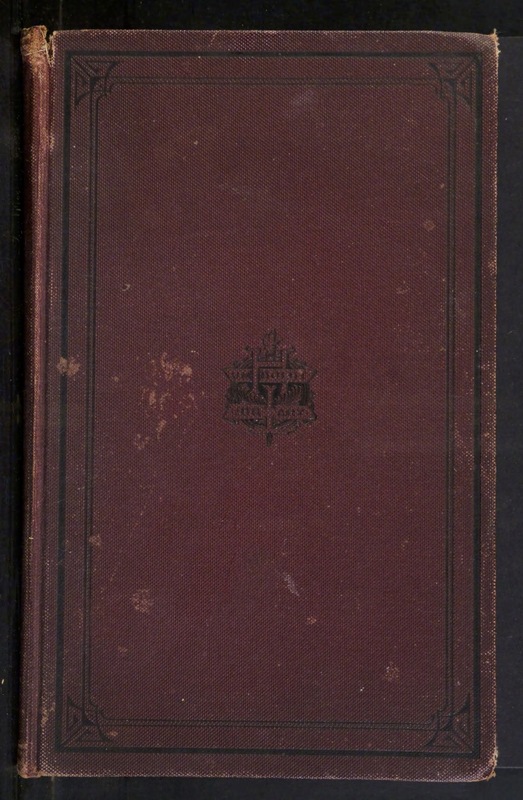 The Descent of Man, and Selection in Relation to SexThis volume is an American pirated edition of The Descent of Man by Charles Darwin, issued in the mid-1880s as part of The Humboldt Library of Science in New York. At the time, the United States did not recognise international copyright, allowing American publishers to reprint British works without paying royalties. Sold for as little as 75 cents (or $1.50 in cloth), this double-columned edition on cheap paper cost a fraction of the authorised John Murray copies imported from Britain, which retailed for $10. Its format reflects a deliberate attempt to make scientific works affordable to a broad readership. Pirated editions were abundant in nineteenth-century America and played a central role in the transatlantic circulation of knowledge. Firms such as the Humboldt Library reprinted popular scientific and literary works quickly and cheaply, often reaching readers far beyond elite institutions. Although European publishers sought to curb this practice in the late century, piracy in this earlier period dramatically expanded access to books, particularly among working- and middle-class audiences. In Darwin’s case, the effects were especially significant. The Descent of Man addressed the evolution of humanity and entered directly into heated debates about race, morality, and civilisation. Cheap American reprints helped carry these arguments into lecture halls, churches, mechanics’ institutes, and private homes. This fragile, inexpensive volume therefore testifies not only to the material culture of nineteenth-century print, but to the crucial role of piracy in transforming evolutionary theory into a global public controversy.
 -
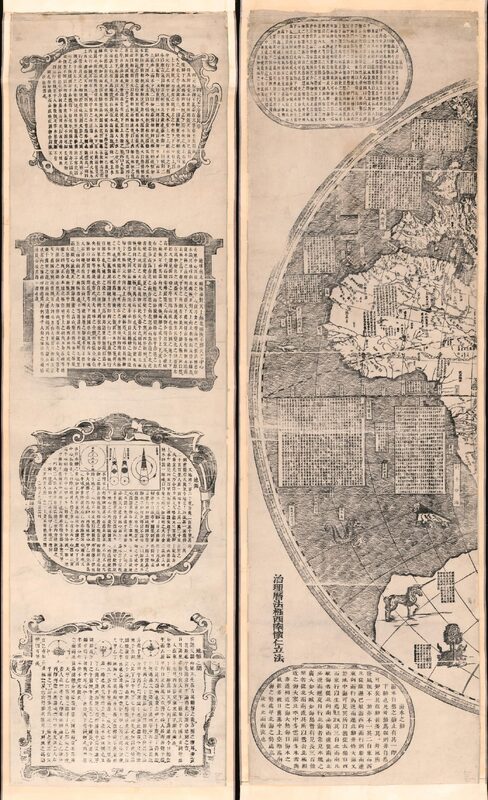 《坤舆全图》Kunyu quantuPresented to the Kangxi Emperor in 1674, Flemish Jesuit Ferdinand Verbiest’s Kunyu Quantu (A Complete Map of the World) is a masterpiece of early modern global synthesis. Far from a mere geographical tool, this eight-panel woodblock map functioned as a dynamic crossroads where European natural philosophy met Chinese aesthetic traditions. The map exemplifies the transnational circulation of knowledge. Verbiest’s cartography drew from Joan Blaeu’s world maps, reflecting contemporary European misconceptions such as California depicted as an island. More strikingly, the map serves as a “paper menagerie”: its depictions of exotic land and sea creatures from the Antipodes are direct descendants of Conrad Gessner’s Historia Animalium and Olaus Magnus’s marine imagery. Here, these creatures — from the pouch-bearing opossum to the enigmatic siren — illustrate how natural history imagery adapted across cultural boundaries. Artistically, the Kunyu Quantu is a harmonious Sino-Western hybrid. While the animals exhibit the three-dimensional shading and anatomical precision of European realism, the physical landscape remains deeply rooted in Chinese sensibilities. The turbulent oceans and jagged peaks employ traditional “scattered perspective” (sǎn diǎn tòu shì) and ink-wash textures, framing the global terrain within the visual language of classical Chinese landscape painting. Surviving maps reveal a complex circulation of material knowledge that extend far beyond the 17th-century Forbidden City. The 1856 Guangdong reissue and the 1860 Korean edition demonstrated Kunyu Quantu’s evolving functions, contexts and cultural value. The biography of individual copies followed separate journeys westward: one passed through the hands of scholars such as the eighteenth-century classicist Theophilus Siegfried Bayer and is now preserved in the Hunterian Museum at the University of Glasgow; another was acquired in China in the 1920s by American missionary John Hummel and entered the Library of Congress.
 -
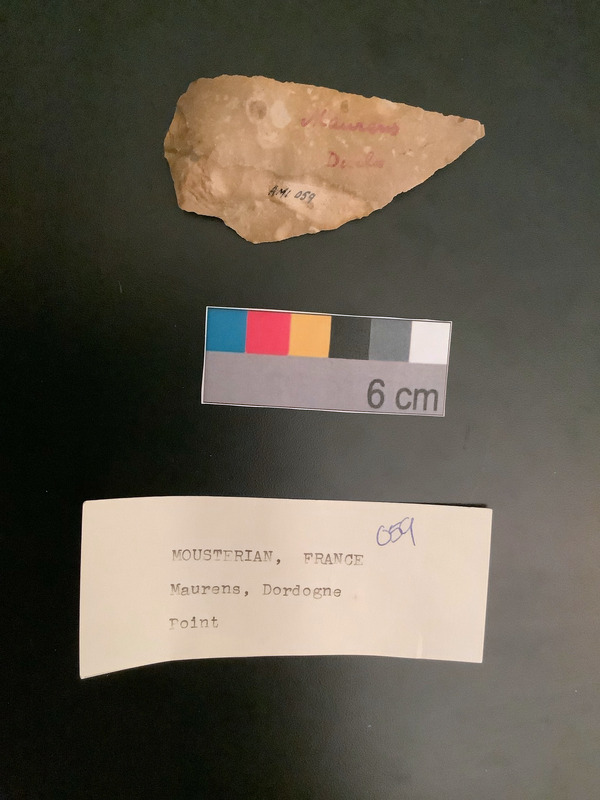 Ami Stone Tools CollectionHenri-Marc Ami made his career at the Canada geological survey, where he became convinced that all humans descended from Neanderthals. In the 1930s he created the Canadian School of Prehistoric Archeology in France and started collecting literally tons of prehistoric stone tools, notably at Combe-Capelle, at a time where no law limited the exportation of prehistoric artifacts. Ami's goal was to create collections for most Canadian university to train future archeologists. The collection speaks to the ethical issues that follow the belief in a shared human history when it comes to the collection and circulation of artifacts, notably with respect to the role it gives to Indigenous populations in human evolution and the role museums play today in the preservation of these collections that were acquired “far away from home”. Some of the tools are marked with labels indicating where they were collected. They are stored in a box along with a letter that indicates how the collection arrived at King’s College from the National Museum, after Ami's death.