
Items
Tag
Astronomy
-
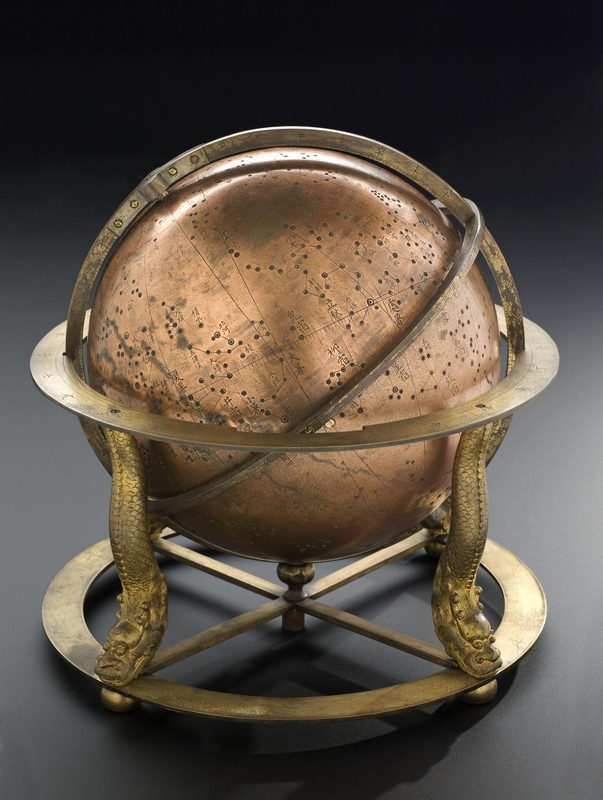 Chinese celestial globeThese globes from 1830 reflect how global exchanges produced new objects of knowledge and how the places where science happened were transformed. Qi Yanhuai, an official from Suzhou, manufactured this globe to update the imperial star catalog called the Compendium of Computational and Observational Astronomy (1723) and its Supplement (1742), the result of efforts by Jesuit and Chinese astronomers. By the 1820s the data was judged to be out of date and consequently astronomers such as Qi Yanhuai and Zhang Zuonan conducted new observations. These globes, therefore, demonstrate how Chinese users applied such translated models for their own purposes. Moreover, these globes expanded the audience for who produced astronomical knowledge. During the 18th century, exchanges occurred primarily at the Imperial court with Jesuit missionaries and other go-betweens. Yet that knowledge was limited. Only a handful of libraries had access to such printed books or manuscripts. These celestial globes aimed to distribute this knowledge more broadly through a different media and experience. They simplified computation and allowed for most educated people to participate. One remarkable feature of these globes is that they also function as clockwork devices. Created by Chinese clockmakers, these mechanisms transferred a global technology into a useful system for Chinese officials and families. The clock reported hours and time according to the traditional system of timekeeping in China, rather than simply a wall decoration. Moreover, since some globes included bells for hours of sunrise and sunset, the clocks could also be used as a practical device for bureaucratic needs to report those times to the city watch. More than just repurposing technology in a local context, Qi Yanhuai claimed that this feature was in fact what made them so useful as knowledge making devices. Although some conservatives viewed elaborate automata as wasteful and unnecessary or as appealing to base senses for popular audiences, Qi said that clockwork allowed one to check and evaluate celestial positions with just a single glance. They made calculations easier. “If your household has one, even your wife and children will be able to know the stars,” he said. Although clockwork connected this device to the world of entertainment, Qi suggested they were “Chinese instruments.”
 -
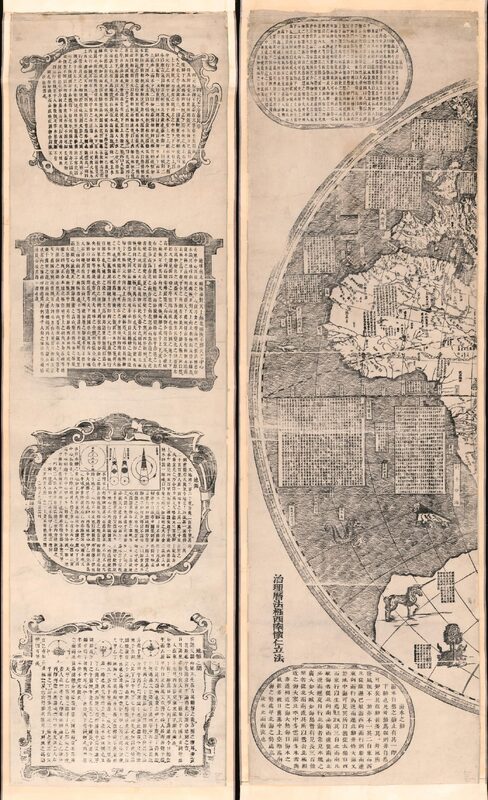 《坤舆全图》Kunyu quantuPresented to the Kangxi Emperor in 1674, Flemish Jesuit Ferdinand Verbiest’s Kunyu Quantu (A Complete Map of the World) is a masterpiece of early modern global synthesis. Far from a mere geographical tool, this eight-panel woodblock map functioned as a dynamic crossroads where European natural philosophy met Chinese aesthetic traditions. The map exemplifies the transnational circulation of knowledge. Verbiest’s cartography drew from Joan Blaeu’s world maps, reflecting contemporary European misconceptions such as California depicted as an island. More strikingly, the map serves as a “paper menagerie”: its depictions of exotic land and sea creatures from the Antipodes are direct descendants of Conrad Gessner’s Historia Animalium and Olaus Magnus’s marine imagery. Here, these creatures — from the pouch-bearing opossum to the enigmatic siren — illustrate how natural history imagery adapted across cultural boundaries. Artistically, the Kunyu Quantu is a harmonious Sino-Western hybrid. While the animals exhibit the three-dimensional shading and anatomical precision of European realism, the physical landscape remains deeply rooted in Chinese sensibilities. The turbulent oceans and jagged peaks employ traditional “scattered perspective” (sǎn diǎn tòu shì) and ink-wash textures, framing the global terrain within the visual language of classical Chinese landscape painting. Surviving maps reveal a complex circulation of material knowledge that extend far beyond the 17th-century Forbidden City. The 1856 Guangdong reissue and the 1860 Korean edition demonstrated Kunyu Quantu’s evolving functions, contexts and cultural value. The biography of individual copies followed separate journeys westward: one passed through the hands of scholars such as the eighteenth-century classicist Theophilus Siegfried Bayer and is now preserved in the Hunterian Museum at the University of Glasgow; another was acquired in China in the 1920s by American missionary John Hummel and entered the Library of Congress.