
Items
Tag
Interpretation
-
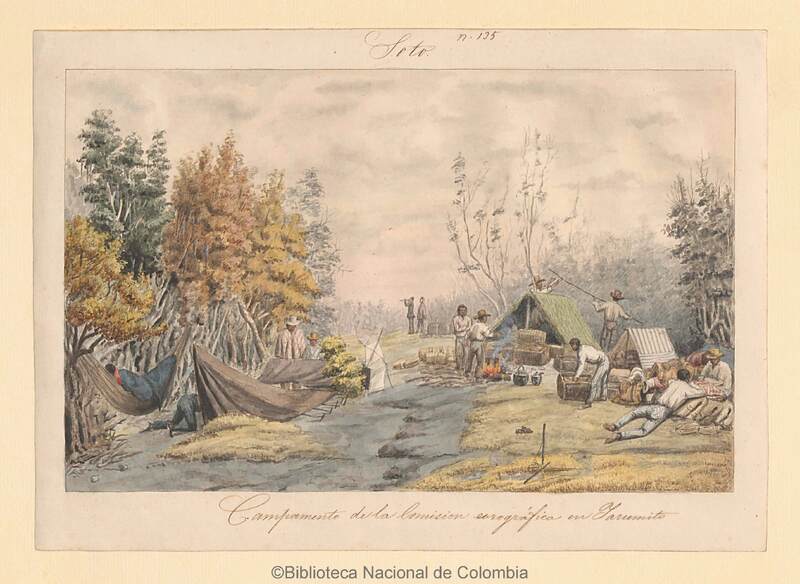 Camp of the Chorographic Commission in Yarumito, Colombia.This watercolor was created by Venezuelan Carmelo Fernández (1809–87), one of the three official draftsmen and painters of the Chorographic Commission, an ambitious Colombian enterprise to map the country, including its mineral resources, between 1850 and 1859. The Commission was led by the Italian born Agustín Codazzi (1793–1859), who involved members of his family: his wife Araceli de la Hoz served as de facto quartermaster, chief logistician, and hostess, while his daughter Constanza and her siblings assisted with reproducing maps. His sons Domingo and Lorenzo also participated in the group’s explorations. The Commission counted on interpreters, porters, muleteers, peons, baqueanos, all led by the butler José Domingo Carrasquel. The watercolor shows a character with a spyglass, presumably a naturalist, and the daily life of the camp, where it was necessary to cook, care for horses and mules, organize samples, notes and reports, as well as pitch and repair tents. Observations were not made in a vacuum, requiring numerous assistants, go-betweens, and wider support networks to make it possible to look, interpret, measure, and collect.
 -
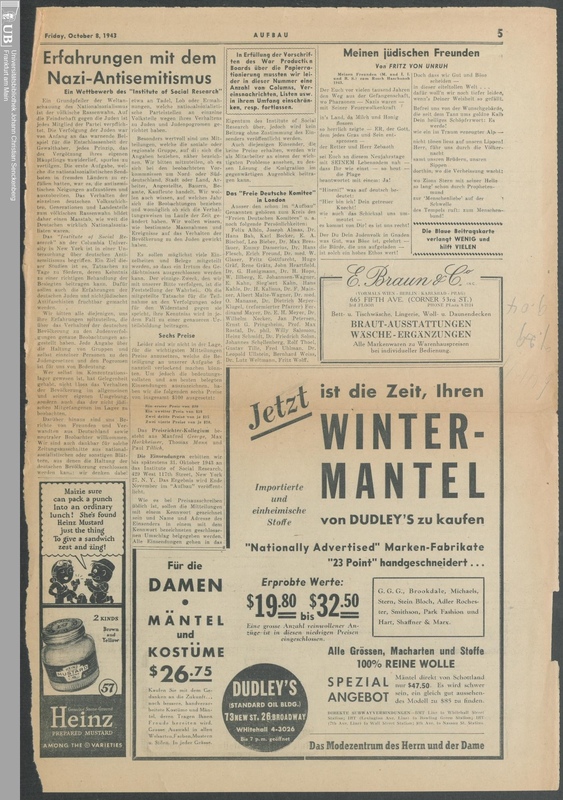 Documents of research on "Experiences about antisemitism" by the Institute of Social ResearchThe three documents displayed here – a German-language call for participation in a research contest, a circular letter to prospective contributors, and a handwritten evaluation sheet – mark the beginning of a collaborative study on antisemitism conducted in 1943 by the Frankfurt scholars of the Institute of Social Research in exile and the American Jewish Committee. Together, they record not only the launch of a research project but the material traces of how knowledge moved across languages, institutions, and political contexts during the Second World War. The magazine article solicited personal testimonies from German-speaking émigrés; the letter framed the project’s aims for contributors; and the evaluation sheet reveals how responses were assessed and categorized. Annotated and handled by multiple actors, the documents embody the layered and collective nature of social scientific production. These materials exemplify the 'circulation of knowledge' through multiple forms of translation. First, there is literal linguistic translation: German émigré scholars addressing displaced German-speaking participants while working within an American institutional framework. Second, there is methodological translation: critical-theoretical concerns about antisemitism were reformulated into empirical social research practices compatible with American scientific discourse and funding structures. Finally, there is institutional translation: a European intellectual tradition, represented by the Frankfurt School, was re-situated within American academia and the Scientific Department of the American Jewish Committee, creating a hybrid space of research shaped by exile, philanthropy, and wartime politics. The later publication of the Studies in Prejudice series (1950), including The Authoritarian Personality, would become the most visible outcome of this exchange, but these modest working documents reveal the practical, multilingual, and collaborative processes that made such intellectual transfer possible.
 -
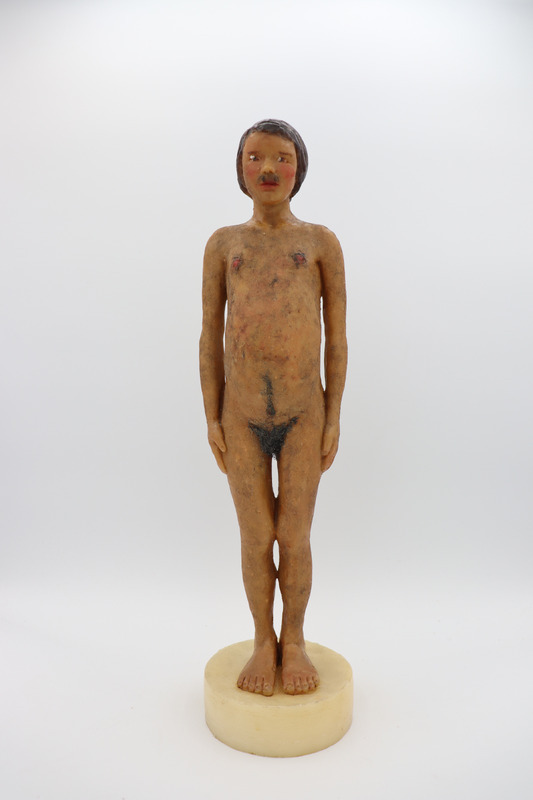 Intersex SomatotypeThis figurine was used during the Second World War to help students without clinical experience ‘recognize’, diagnose, and treat the supposedly pathological traits of intersex peoples’ bodies. As a teaching aid and visual representation, this somatotype demonstrates medical and scientific institutions’ role in solidifying oppressive biases across generations of practitioners. The project that created these somatotypes was inspired by similar models made at Johns Hopkins in the United States, showing how a transnational network of medical expertise interacted with the local practices solidifying the pathologization of intersex people among Canadians. In a 1999 interview, Marjorie Winslow (the artist) recalled that Dr. Robertson encouraged her to exaggerate the 'abnormal' qualities while sculpting the somatotypes. In this case, Winslow used actual human hair to simulate the body hair, pubic hair and moustache that physicians viewed as indicative of the supposed ‘pathology’.
 -
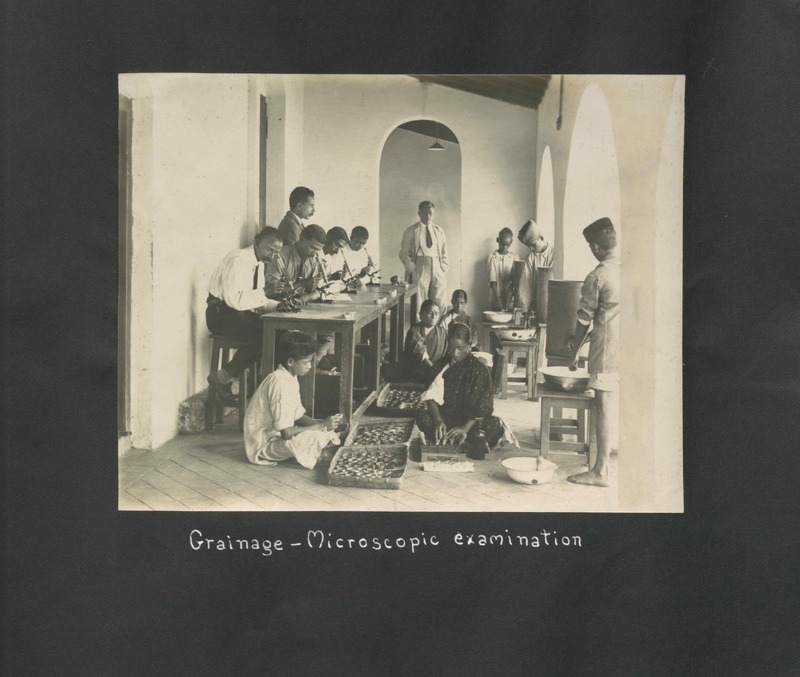 Grainage-Microscopic Examination, Mysore Sericulture DepartmentThis image is from a 1925 photo album (image no. 14 in the listed archival identifier) from the Mysore Sericulture Department in Mysore state, in India. The album showcases a diversity of images from the sericulture process, starting from the cultivation of silkworms, all the way to the production and packing of raw silk. The image is from a collection of material related to Leslie Coleman, a Canadian entomologist, who was initially hired by the Maharaja of Mysore to solve a pest problem in their areca plantations. During his time, he was instrumental in setting up agricultural practices and education, and also extending the sericulture work in the Mysore state. The album’s purpose did seem to be a demonstration of the entire process of running a silk farm. We can’t say for certain who is the photographer, or what prompted Coleman to keep this album (the Archives at NCBS does not have similar albums for other farming processes). But the album and Coleman’s collections are indicative of his cross-cultural moves across colonial empires, from Canada to Germany and eventually to Mysore, India. The object also showcases the technologies that had been established before the arrival of Coleman, in conversation with the Japanese in the late 19th century, including bringing in experts and machinery. This image has an innocuous sounding title, focusing on the 'Grainage-Microscopic Examination' that is integral to sericulture. But we also see the emergence of other societal themes. A group of men sit on chairs and peer at the microscopes; children and women sit on the floor tending to preliminary steps; and a supervisor-like man oversees the examination. This fragment prompts questions around the hierarchy of science, and brings to fore layers of gender, class, caste and labour that anchor sericulture work.
 -
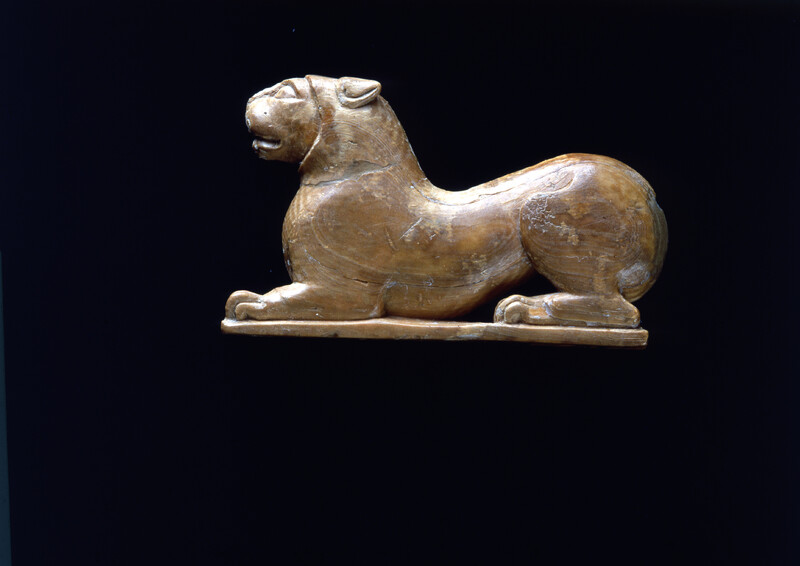 Tessera HospitalisThis object is an ivory lion Tessera, from the sanctuary under Sant’Omobono in Rome. It dates in the range from 7th to 6th centuries BC and has a caption inscribed in Etruscan, the name: Araz Silqetenas Spurianas. The other half of this lion would have been inscribed with whoever Araz had made this pact of friendship with, likely someone from another city or another land, even overseas as far as north Africa or the other reaches of the Mediterranean and beyond. This object is testament of a link between this Etruscan-speaking guest-friend and another. These objects would have formed part of a wider system of private contracts and hospitality on which the Mediterranean network was based. The remains of banqueting and commensality that would have been crucial to maintaining these ties are found in the elite burials of both men and women, and scenes of such activities – banqueting, games, and processions – proliferate on tomb paintings and are a favourite subject of artists, depicted on vessels of all kinds, and in epics – not least those of Homer. They all attest to the circulation of people, objects, both as commodities and as containers of cultures, stories and knowledge. Hospitality allowed for the opening up of networks and importantly for bringing those who are unknown into the realm of the familiar, thus creating intersections of knowledge-exchange. This was materialised in objects such as this tessera hospitalis – a record of reciprocity – that acted as a binding contract extending over geographic distances and generations.
 -
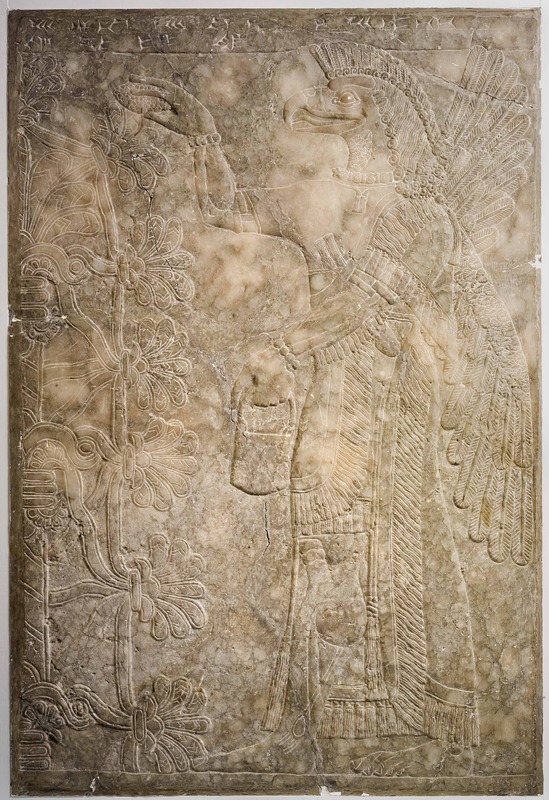 Apkallu with eagle head from the Palace of Ashurnasirpal IIThis sculpture is of an ancient Assyrian mythological figure known as an Apkallu. Apkallu often exhibit characteristics from different groups of animals mixed together; this one has an eagle’s head and wings with the body of a human. It was extracted from the Palace of Ashurnasirpal II near Mosul and brought to Amherst College in Western Massachusetts in the mid-19th century during a period of financial, ecological, and political change. Upon its arrival at Amherst it was placed adjacent to the college’s most famous collection: the world’s first cabinet of fossil footprints. Local naturalists believed that the footprints were left by Jurassic creatures that also mixed characteristics from different living groups, combining anatomical parts from birds, lizards, frogs, and marsupials. Juxtaposing the Assyrian sculptures and the fossil footprints, later known to be made by dinosaurs, helped denizens of the area situate themselves within both human and natural history. The Apkallu was interpreted by 19th century faculty as an attempt by ancient Assyrians to symbolize the power of the Creator by combining the swiftest, strongest, and wisest animals in creation. The Jurassic footprints, meanwhile, were seen as evidence that God had created actual animals with equally fantastical adaptations. Yet, the greatest adaptations, for New Englanders, were not physical but mental, i.e. the capacity to think, act, and behave differently. By showing that they could understand a wide range of phenomena, from Assyrian myths to Jurassic creatures, they were displaying their ability to change their frame-of-mind; to show that as the world changed, they could as well. Curators, artists, and historians are now searching for ways to give these sculptures new functions and meanings. Centuries of looting and military operations have, meanwhile, destroyed many of the remaining sculptures in the original Assyrian Palaces. For the artist Michael Rakowitz, the loss of these historical objects nor their interpretation within museums can be disentangled from the loss of contemporary lives and livelihoods due to war. In response, Rakowitz has reconstructed the destroyed sculptures using intricately plastered wrappers from Middle Eastern food stuffs found in American grocery stores. By reconstructing the sculptures using mediums that families from the Middle East would have encountered when reuniting in America, these “ghosts” or “specters,” as Rakowitz calls them, remind us both of loss but also the potential for healing, restitution, and resurrection.
 -
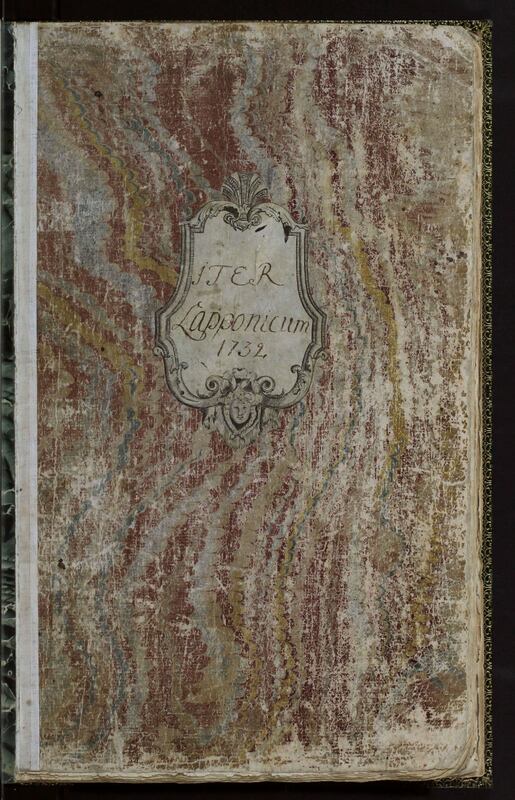 Iter LapponicumIn the summer of 1732, the 25-year old medical student Carl Linnaeus undertook a journey to Northern Fennoscandia, which was funded by the Royal Scientific Society in Uppsala. During the journey, he produced a diary that detailed his observations and experiences. This was not a diary in the strict sense of the word, but rather compiled towards the end of the journey from earlier notes. Accordingly, it presents a mix of genres: first-person accounts — sometimes in the first person plural since Linnaeus was often accompanied by local guides — of interactions with settlers and the indigenous Sámi; third person descriptions, sticking to the "anthropological" present, of the nature and culture of Sápmi (Lapland) which were based on conversations Linnaeus had with clergy and schoolmasters who hosted him in colonial outposts like Lycksele and Kvikkjokk; and drafts for academic essays, for example answering the question why the Sámi reindeer herders "are so fleet at foot". The diary was originally stored in the form of loose leafs in a leather cover (which is also preserved in the Linnean Society's collections). Some time after his return to Uppsala, Linnaeus bound it in cardboard, and applied a decorative label which he inscribed with the title and the year of the journey. In 1784, the English naturalist James Edward Smith purchased the diary as part of Linnaeus's collections from the latter's widow Sara Elisabeth Moræa. It was Smith also who prepared an English translation, which was published as Lachesis lapponica; or A Tour in Lapland in 1811. It became a paragon of scientific travel writing in the nineteenth century.
 -
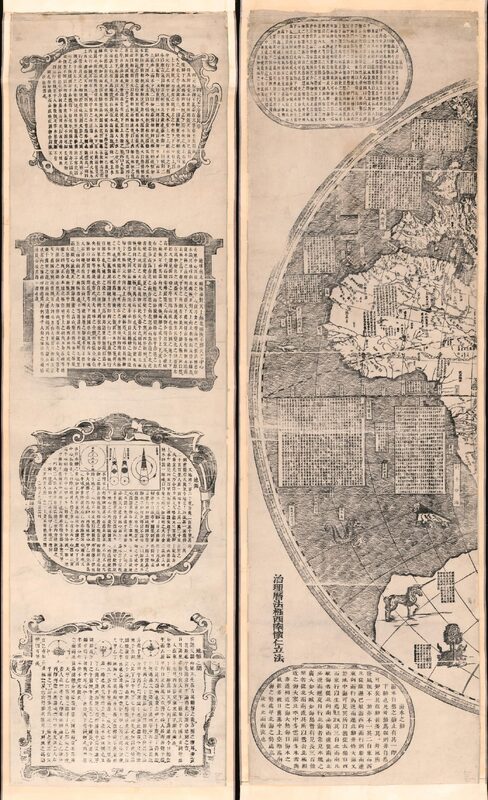 《坤舆全图》Kunyu quantuPresented to the Kangxi Emperor in 1674, Flemish Jesuit Ferdinand Verbiest’s Kunyu Quantu (A Complete Map of the World) is a masterpiece of early modern global synthesis. Far from a mere geographical tool, this eight-panel woodblock map functioned as a dynamic crossroads where European natural philosophy met Chinese aesthetic traditions. The map exemplifies the transnational circulation of knowledge. Verbiest’s cartography drew from Joan Blaeu’s world maps, reflecting contemporary European misconceptions such as California depicted as an island. More strikingly, the map serves as a “paper menagerie”: its depictions of exotic land and sea creatures from the Antipodes are direct descendants of Conrad Gessner’s Historia Animalium and Olaus Magnus’s marine imagery. Here, these creatures — from the pouch-bearing opossum to the enigmatic siren — illustrate how natural history imagery adapted across cultural boundaries. Artistically, the Kunyu Quantu is a harmonious Sino-Western hybrid. While the animals exhibit the three-dimensional shading and anatomical precision of European realism, the physical landscape remains deeply rooted in Chinese sensibilities. The turbulent oceans and jagged peaks employ traditional “scattered perspective” (sǎn diǎn tòu shì) and ink-wash textures, framing the global terrain within the visual language of classical Chinese landscape painting. Surviving maps reveal a complex circulation of material knowledge that extend far beyond the 17th-century Forbidden City. The 1856 Guangdong reissue and the 1860 Korean edition demonstrated Kunyu Quantu’s evolving functions, contexts and cultural value. The biography of individual copies followed separate journeys westward: one passed through the hands of scholars such as the eighteenth-century classicist Theophilus Siegfried Bayer and is now preserved in the Hunterian Museum at the University of Glasgow; another was acquired in China in the 1920s by American missionary John Hummel and entered the Library of Congress.
 -
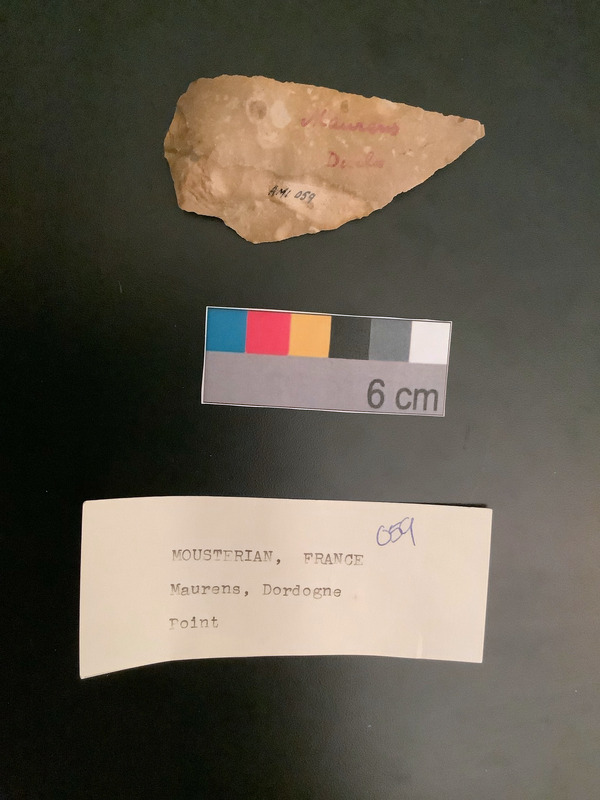 Ami Stone Tools CollectionHenri-Marc Ami made his career at the Canada geological survey, where he became convinced that all humans descended from Neanderthals. In the 1930s he created the Canadian School of Prehistoric Archeology in France and started collecting literally tons of prehistoric stone tools, notably at Combe-Capelle, at a time where no law limited the exportation of prehistoric artifacts. Ami's goal was to create collections for most Canadian university to train future archeologists. The collection speaks to the ethical issues that follow the belief in a shared human history when it comes to the collection and circulation of artifacts, notably with respect to the role it gives to Indigenous populations in human evolution and the role museums play today in the preservation of these collections that were acquired “far away from home”. Some of the tools are marked with labels indicating where they were collected. They are stored in a box along with a letter that indicates how the collection arrived at King’s College from the National Museum, after Ami's death.