
Sample of Teak
- Title
- Sample of Teak
- Date Created
- 2 September 1847
- Creator
- N/A
- Identifier
- E00643254
- Original Location
- Karnataka, Mysore, India
- Current Location
- Royal Botanic Garden Edinburgh, United Kingdom
- Description
-
This carefully mounted and framed teak specimen from Karnataka (Mysore), collected on 2 September 1847, reveals how the material practices of museum curation can obscure the true circulation of knowledge.
These institutional stamps and codes layer bureaucratic authority onto the object. Two stamps from two herbarium collections – that of Cleghorn and Wight – on the same herbarium sheet reveal something unusual. That is, this sample is actually not one sample but two, divided by the faint pencil line that goes around the shape of the mature teak leaf. The sample of the flower and young leaf originally belonged to the Cleghorn collection, while the rest belonged to the Wight collection. It may be the case that the Royal Botanic Garden of Edinburgh reorganised and put these two samples together on one sheet. The specimen is identified by its scientific name as Tectona grandis, followed by its common name, Malabar Teak, and the collection date. Below sits the stamp of the Flora of Madras, accompanied by det. J.S. Gamble and dated 1913 – James Sykes Gamble (1847–1925), British botanist and forester, who authored The Flora of the Presidency of Madras, a foundational three-volume botanical work (completed by C.E.C. Fischer) where Tectona grandis appears in volume 1.
The specimen reflects British colonial administrators' and scientists' growing interest in teak, a precious hardwood long valued and utilised by communities across South and Southeast Asia, before colonial powers systematically managed and exploited this resource through the emerging knowledge system of tropical forestry. The object's physical presentation—its careful preservation, institutional framing, and coded classification—creates an appearance of purely Western scientific authority while simultaneously concealing the essential contributions of local informants, forestry workers, or indigenous botanical knowledge holders who may have been involved in its collection. This erasure is particularly significant given that the specimen was collected in 1847, prior to the creation of the Indian Forest Service (1864), and its collection would necessarily have depended on local knowledge and labour.
The development of tropical forestry challenges assumptions of unidirectional knowledge flow from West to East. Instead, tropical forestry knowledge emerged in British India and subsequently spread to the United Kingdom—a circulation from colony to metropole. - Credit
- Royal Botanic Garden Edinburgh. Edinburgh (E) Herbarium Specimens. Occurrence dataset https://doi.org/10.15468/ypoair accessed via GBIF.org on 2024-08-02. https://www.gbif.org/occurrence/789977582
- Contributor
- Dr. Patcharaviral C. Schuessler, Faculty of Arts, Chulalongkorn University, Bangkok
- Item sets
- The Things They Carried Exhibit
- Site pages
- Map
- Media
-
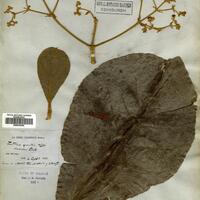 Tectona grandis L.f.
Part of Sample of Teak